
Prepare for the Hard Reset
The world in March 2026 does not need a war to start World War Three. It needs a mistake. World War Three, if it begins, is unlikely to start with one formal declaration or two clean blocs. It is more likely to form as a chain reaction — separate wars and crises connecting through chokepoints, alliance commitments, sanctions shocks, and domestic breakdowns until escalation control simply fails. (House of Commons Library) The ingredients are already assembled: an active US-Iran war, Russian drones breaching NATO airspace, Iranian missiles being shot down over Turkey without Article 5 being invoked yet, New START expired with no replacement, and China conducting full naval encirclement drills around Taiwan. Three Iranian ballistic missiles have already been intercepted over Turkish airspace on March 4, 9, and 13 alone. (Al Jazeera) Each one of those was a potential trigger that was not pulled — this time. On February 5, 2026, the New START treaty expired, leaving no binding limits on the strategic arsenals of the two largest nuclear powers, describing a world where crises move faster, signals are harder to read, and leaders have less room for error. (House of Commons Library) A downed aircraft over a NATO border, a miscalculated missile strike, a cyberattack that blacks out a national grid, a commander in the field who does not wait for orders — any one of these is sufficient. History’s worst wars were not planned. They were triggered.
The safe haven playbook has been rewritten in real time. Dubai’s gold freight is suspended. Stock exchanges across the Middle East have closed. Banks in conflict zones are frozen or inaccessible. And yet Bitcoin is trading, Ethereum is settling, and decentralized exchanges have not missed a single block. The question is no longer whether crypto survives a war. It already is. The question is which assets, held how, are the smartest choices right now.
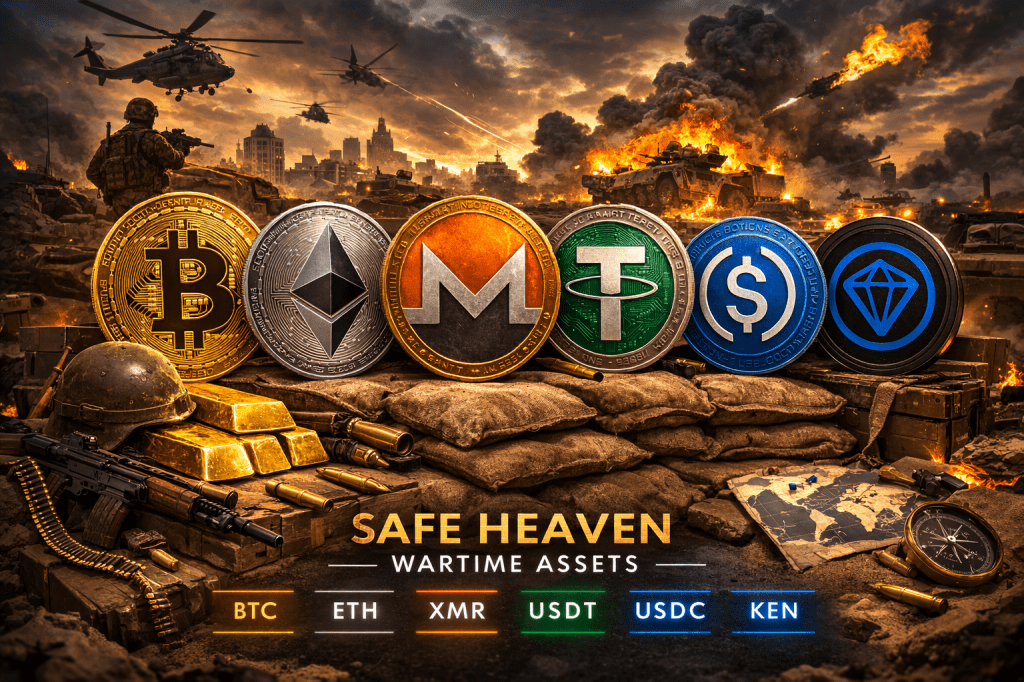
Physical assets fail at the border. You cannot fly gold out of Dubai when airspace is closed, truck it when border crossings are blocked, or liquidate real estate when buyers have fled. Banks fail under systemic stress through capital controls, bail-in laws, and frozen wire transfers. Crypto, by contrast, lives in a 12-word seed phrase in your mind, crosses every border invisibly, and is accessible from any device via Starlink satellite internet from virtually anywhere on Earth.
Bitcoin is the sovereign store of value. Its fixed 21 million supply cap cannot be debased by any central bank, its blockchain is broadcast from orbit 24/7 via Blockstream Satellite requiring zero terrestrial internet, and institutional holders now exceed 172 publicly traded companies holding roughly one million BTC collectively. It sells off in the initial shock of a conflict then recovers and outperforms. Hold it long term, in self-custody, never on an exchange.
Ethereum is the financial operating system. Secured by over one million globally distributed proof-of-stake validators with zero successful consensus attacks in its history, it powers every decentralized exchange, every DeFi protocol, and every tokenized asset. When traditional financial markets close, Ethereum stays open. Two major upgrades in 2026 deepen its decentralization further and orbital satellite nodes are already in development. For anyone needing a borderless financial infrastructure rather than just a store of value, Ethereum is the foundation.
KEN, the utility token of Kohenoor Technologies’ HyFi ecosystem, runs on Ethereum Mainnet Chain ID 1 — inheriting the full security, decentralization, and satellite accessibility of the world’s most resilient smart contract network. In a world where hybrid finance infrastructure is no longer a luxury but a survival necessity, KEN represents the next layer above base-layer crypto: a purpose-built financial intelligence ecosystem designed to operate precisely when traditional systems cannot. The current global crisis is not a threat to the KEN thesis. It is its validation.
Stablecoins such as USDC and USDT serve as the wartime liquidity layer, processing tens of trillions in transactions annually and providing instant access to dollar-equivalent purchasing power with no bank account required. Tokenized gold such as PAXG captures gold’s safe-haven value — which surpassed $5,200 per ounce in 2026 — without any of the physical logistics that have proven catastrophically impractical in the current conflict. Privacy coins, particularly Monero, serve as an extreme scenario hedge for those in sanctioned jurisdictions needing untraceable transactions.
The optimal wartime stack is simple: Bitcoin for long-term value preservation, Ethereum and KEN for financial infrastructure and utility, stablecoins for liquidity, tokenized gold for safe-haven exposure, and a hardware wallet holding it all with a seed phrase that exists only in your memory. Add Starlink for connectivity and no border, no government, and no airstrike can touch your wealth.
This is not the future of finance. It is the present, and it is already working.
This article is for informational purposes only and does not constitute financial advice.
Ahmad Bilal Khan is the Founder and CEO of Kohenoor Technologies, builders of the KEN/HyFi Hybrid Finance Intelligence Infrastructure on Ethereum Mainnet.

 KOHENOOR
Leave a comment